
Tear trough
Tear trough fillers, also known as tear trough fillers, serve to strengthen the skin under the eyes and reduce dark circles. This is a common concern, even at a young age, and it’s a concern that increases with age. People often worry about dark circles, shadows, and excess skin or fat under the eyes.
- Price: €400
- Treatment time: 30 minutes
- Effect: 9 tot 12 months
Note: In some cases, such as significant under-eye bags or excess skin, surgical eyelid surgery may be the only effective treatment.
Are you also concerned about fine lines around your eyes (crow’s feet)? Consider BTX muscle relaxants.
By strengthening the skin under your eyes, wrinkles can be prevented and dark circles reduced.
Applications of Tear Trough Filler or Under-Eye Filler:
This treatment is ideal for people who suffer from:
- Under-eye hollows (insufficient fat volume)
- Dark shadows under the eyes
- Dark circles under the eyes
Which Tear Trough Fillers Do We Use?
We choose products that provide effective filler without attracting excessive fluid. The fillers specifically formulated for this area are more fluid than other fillers, which minimizes the formation of lumps.
How Does a Tear Trough Filler Treatment Work?
A step-by-step explanation of how a tear trough filler treatment takes place.
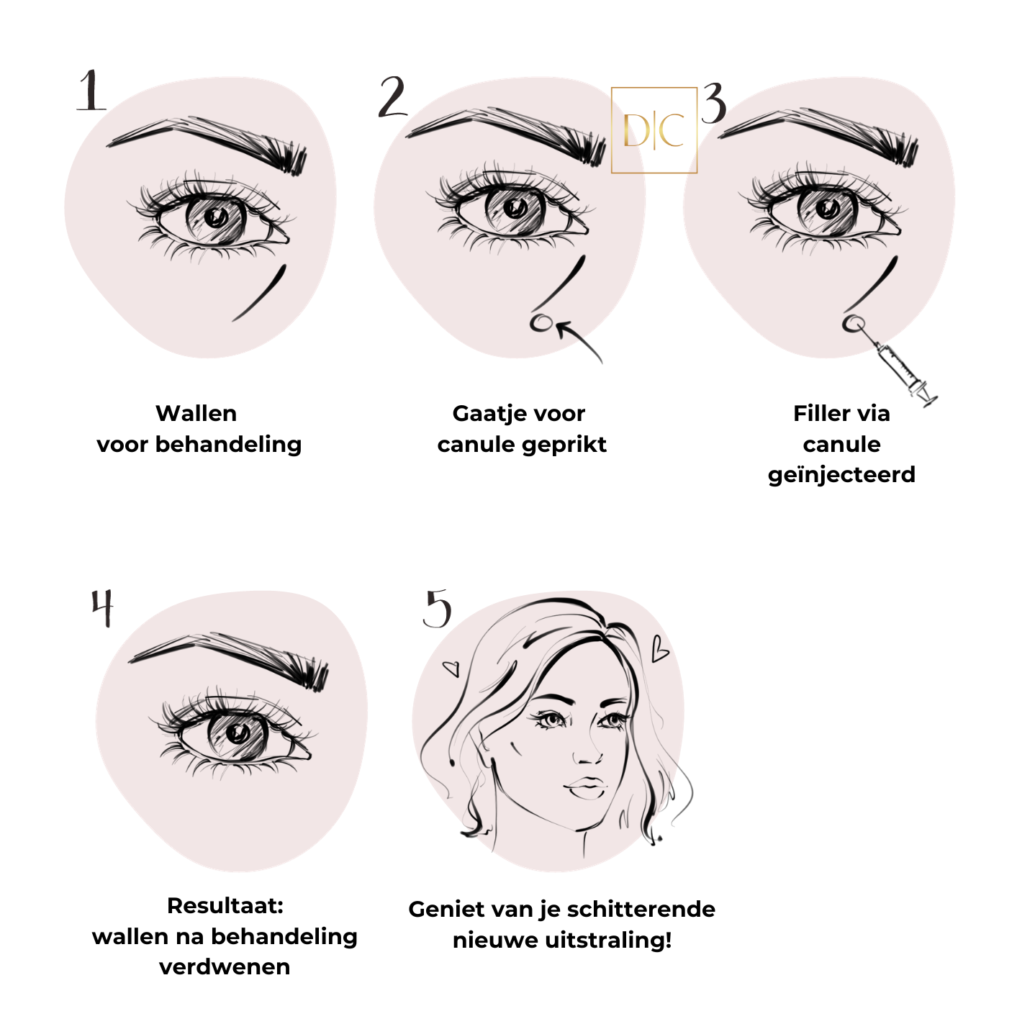
Are There Complementary Treatment Methods?
Yes, absolutely! Combining treatments, such as tear trough fillers with PRP or Skinboosters, can have synergistic effects and contribute to optimal skin condition, thus enhancing the results of the tear trough filler treatment.
Voor- en Nazorg bij Traangootfiller
- Vermijd make-up gedurende de eerste 4 uur na de behandeling
- Geen intensieve lichaamsbeweging op de dag van de behandeling
- Gebruik geen zure producten op de huid voor 24 uur na de behandeling
- Bezoek geen spa’s, sauna’s, of warme yoga sessies tot 1 week na de behandeling

Prijzen Fillers
-
Lip Fillers €280/subtiel resultaat, €350/volume resultaat
-
Neus Fillers: neusbrug en eventueel neustip €400
-
Traangoot Fillers €400/behandeling (inclusief follow-up na 2 weken)
-
Liquid facelift (filler midface) €350/1 ml, €620/2 ml, €850/3 ml, €1000/4 ml
-
Wenkbrauwlift met fillers vanaf €350
-
Fillers oorlel Vanaf €250
-
Neustiplift (Thinkerbell lift) vanaf €350
-
Opvullen holle tempels vanaf €400
-
Fillers definitie kaaklijn: vanaf €350
-
Hyaluronidase (correctie foutieve filler) Vanaf €150/behandeling
Er wordt bepaald naargelang de indicatie of echografie hierbij noodzakelijk is. Indien echografie wordt gebruikt, wordt er €50 extra aangerekend.
-
Haar fillers kleine zone €220/behandeling
-
Haar fillers middelgrote zone €320/behandeling
-
Haar fillers grote zone €420/behandeling
-
Billen fillers (vergroting of opvullen hip dips) €2000 (NIEUWE PRIJS)
100 ml (verspreid over 1 a 2 sessies
-
Billen fillers (vergroting of opvullen hip dips) €3600
200 ml (verspreid over 2 a 3 sessies)
-
Billen fillers (vergroting of opvullen hip dips) €5400
300 ml (verspreid over 2 a 3 sessies)
-
Kin fillers vanaf €350
FAQ
Our tear trough fillers contain a small dose of anesthetic, which is usually sufficient to minimize discomfort. If a patient desires additional comfort, a numbing cream can be applied. However, be careful: this cream can cause swelling under the eyes, which may affect the accuracy of the treatment. If a cannula is used, a separate local anesthetic can be administered prior to the procedure. After the treatment, cold packs can help reduce any pain, swelling, and bruising.
Before treatment begins, you and the doctor will have a thorough consultation. During this consultation, your wishes and expectations will be discussed so the doctor can discuss the most appropriate treatment and associated costs with you. To minimize the risk of infection, the area to be treated will be thoroughly cleaned with alcohol and chlorhexide. The doctor will then inject the tear trough filler with a needle into the desired area. After the injection, gauze will be applied to the treated area to minimize any swelling. If a cannula is used for the treatment, a small amount of local anesthetic may first be injected into the skin. A minimally invasive opening will then be made in the skin where the cannula will be inserted. Rest assured: this opening will no longer be visible after the treatment.
After the treatment, redness, swelling, and possibly bruising may occur at the injection sites. Specific aftercare instructions include:
- Avoid makeup for the first 4 hours
- No intense physical activity on the day of the treatment
- Avoid acidic skin products for 24 hours
- No spas, saunas, or hot yoga for 1 week
The effect of the fillers is visible immediately after treatment. Most swelling subsides within 2 to 3 days, but mild swelling may persist for 2-4 weeks. Any bruising may remain for up to 7-8 days.
The treatment may involve risks, including:
- Bruising
- Swelling at the injection site
- Tyndall effect (bluish sheen under the skin)
- Lumps
- Asymmetry
- Infection
- Necrosis (very rare, and at Doctor Contour Clinic, we always have hyaluronidase available to reverse any complications)
Possible need for additional treatments
It is normal for tear troughs to be slightly asymmetric, and Dr. Kim Detollenaere strives to correct this as much as possible. In the initial post-treatment phase, temporary asymmetry may occur, especially if one side is more swollen or bruised than the other. In most cases, these differences will diminish on their own by the time of your follow-up appointment. If the asymmetry persists, it can be thoroughly assessed during a subsequent appointment. It is generally not helpful to come for a follow-up appointment earlier than planned specifically for asymmetry, as swelling is common and the final result will not be fully visible for at least two weeks after treatment. Intervention performed too early can even worsen the asymmetry. If necessary, additional treatment can be considered to further optimize the symmetry.
The injection itself takes on average only 15 minutes, but including the consultation, you should count on a total visit to the clinic of about 45 minutes.
The durability of the effect varies and is primarily based on the amount of filler administered by the doctor. It’s reasonable to expect the results to last for approximately eight months. After this period, it’s recommended to repeat the treatment at least annually. The filler is composed of hyaluronic acid, a substance that is gradually broken down by the body.
This varies depending on the patient’s individual anatomy and the desired result. The doctor will estimate the amount needed to achieve the desired outcome, using a gradual approach.